Menopausal Tendonitis Treatment: A Physical Therapist's Guide
Treating tendonitis during menopause requires more than rest and anti-inflammatories. The most effective approach centers on progressive loading, a method physical therapists use to gradually increase the force placed on a tendon so it can remodel, adapt, and become stronger over time.
Isometric and eccentric exercises each play a distinct role in tendon rehabilitation, and the right combination depends on the tendon involved, current pain levels, and where someone is in the healing process. Nutrition, sleep, and consistent strength training are equally important factors that support tissue repair and long-term tendon resilience.
Women in menopause dealing with persistent tendon pain benefit most from a structured, personalized plan rather than generic advice. Programs like Meno-Strength RX are designed to give women in midlife the progressive, guided approach their tendons need to recover and stay strong.
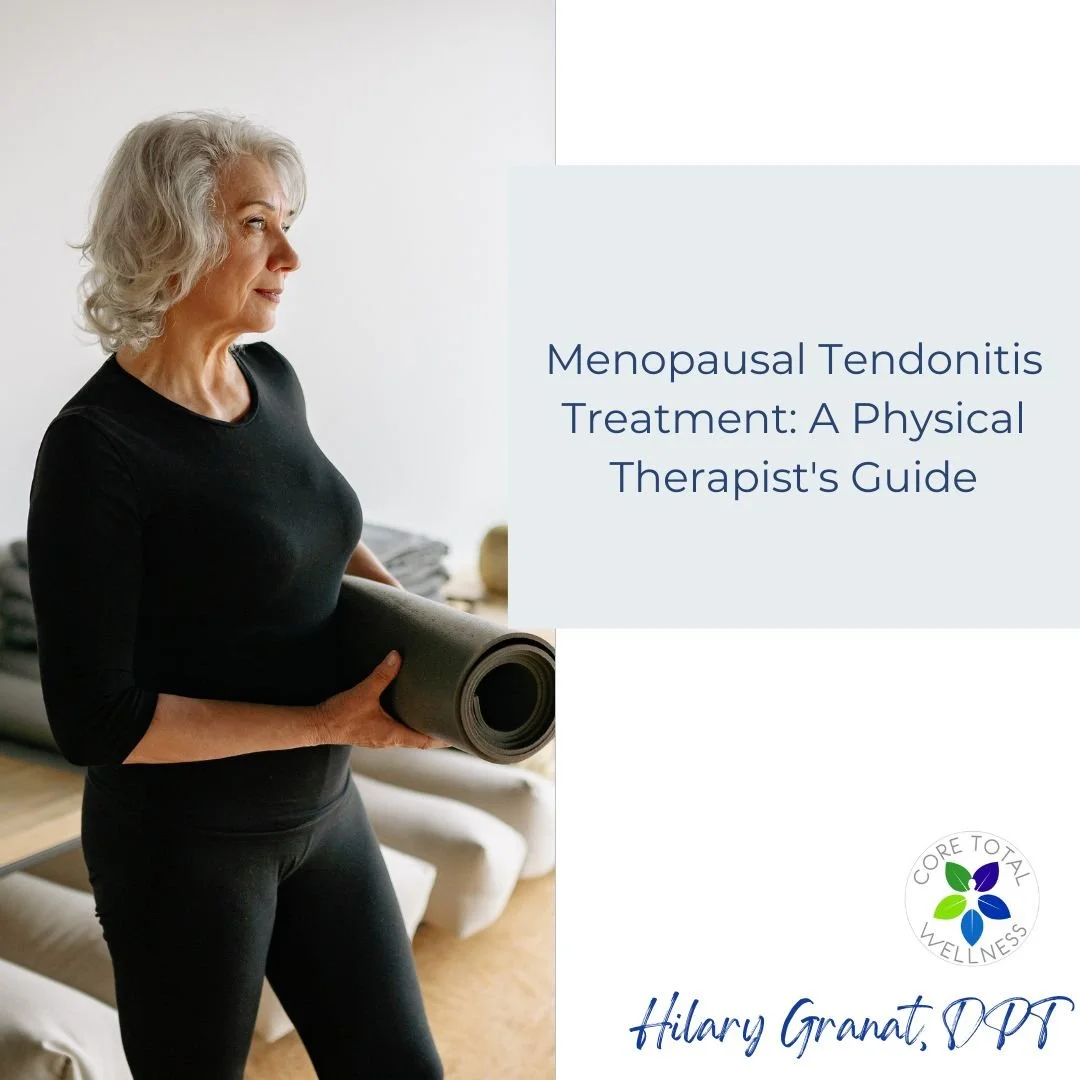
If you've been diagnosed with tendonitis or you've been dealing with stubborn tendon pain during menopause, you've probably been told to:
"Just rest it." "Take some ibuprofen." "Stop exercising until it feels better."
As a physical therapist, I can tell you that while those suggestions may help temporarily, they usually don't solve the problem.
The Secret to Healthy Tendons? Load them.
This may sound surprising, but tendons actually need load to stay healthy. Unlike a muscle strain that may need a short period of rest, tendons are load-dependent tissues. That means they become stronger and more resilient when they're challenged with the right amount of stress over time.
In fact, doing too little can be just as problematic as doing too much. The goal isn't to avoid loading the tendon, but to load it gradually and progressively so it can adapt and become stronger.
As physical therapists, we use a treatment approach called progressive loading, which simply means gradually increasing the amount of force going through the tendon over time. Depending on the tendon involved and your symptoms, this may include:
Progressive strength training, which uses controlled, progressively heavier loads to build strength and improve the tendon's ability to tolerate force. To help your tendon heal you need to progressively load your tendon 3 times a week for 9-12 months according to research. You need to increase your activity gradually and give your tissues time to adapt. Loading the tendon allows it to remodel and heal into a stronger tendon.
Eccentric exercises, where the muscle slowly lengthens under tension. These have long been a cornerstone of tendon rehabilitation and remain a very effective treatment option.
Isometric exercises, where the muscle contracts without moving the joint. These can be especially helpful in the early stages of rehabilitation because they allow you to load the tendon while minimizing movement and may help reduce pain.
The key is finding the "Goldilocks zone" which means not too much, not too little, but just enough to encourage healing without significantly increasing your pain. Mild discomfort during exercise can be normal with tendinopathy, but your symptoms shouldn't be significantly worse the next day.
Rest alone rarely fixes tendon pain. The right amount of progressive loading is one of the most effective ways to help tendons adapt, become stronger, and reduce pain.
The specific exercises you perform will depend on the tendon involved, your pain level, and where you are in the healing process. That's why a personalized physical therapy rehab program is often more effective than trying random exercises you find online.
Why do we use isometric exercises for tendon pain?
One of the biggest benefits of isometric exercises is that they can help reduce pain while still loading the tendon. Although tendons need load to stay healthy, sometimes they are just too irritated for heavier or more dynamic exercises. Isometric exercises allow you to keep the tendon active without moving it through a full range of motion.
For many people, they're a great way to calm things down before progressing to more challenging strengthening exercises.
Some examples include:
Patellar tendinopathy (knee pain): Holding a wall sit for 30–45 seconds.
Achilles tendinopathy: Rising onto your toes and holding the position.
Rotator cuff tendinopathy: Gently pushing your hand into a wall without moving your arm.
Gluteal tendinopathy: Holding a bridge at the top instead of repeatedly lifting and lowering your hips.
Tennis elbow: Holding a light weight with your wrist extended without moving it.
In my physical therapy clinic, I often use isometric exercises early in rehabilitation when movement is too painful or as a warm-up before progressing to more dynamic strengthening exercises.
What About Eccentric Exercises?
Eccentric exercises involve slowly lengthening the muscle while it's under tension. Think about slowly lowering your heel off a step during a calf raise for Achilles tendinopathy or slowly lowering a dumbbell during a bicep curl. Eccentric exercises are particularly effective in promoting tendon healing and strengthening.
For years, eccentric exercises were considered the gold standard for treating tendinopathy because they help stimulate the tendon to remodel and become stronger. Today, we know that progressive loading is the real key. Eccentric exercises remain an excellent treatment option, but they're just one way to progressively load a tendon. Depending on the tendon involved and where you are in your recovery, I may also prescribe heavy slow resistance training or other strengthening exercises.
The goal isn't to find one "magic" exercise, but it's to gradually increase the tendon's capacity to tolerate load so you can return to the activities you enjoy with less pain and greater confidence.
Six Ways to Help Your Tendons Heal
The good news? Tendons are incredibly adaptable. With the right approach, you can improve tendon health and reduce your risk of future problems.
1. Keep Strength Training
If you've followed me for any length of time, you knew this was coming! Strength training doesn't just build muscle. It strengthens tendons, too.
Progressive resistance training helps tendons become better at tolerating force, which can reduce pain and lower your risk of future injury. Aim for at least two to three full-body strength sessions each week.
2. Progress Gradually
Our enthusiasm sometimes gets us into trouble. The key is not to do too much, too soon. I have seen many patients who as soon as they start feeling better rush to get back to tennis or running.
I see it all the time in my clinic. Women are motivated, active, and ready to keep doing all the things they love, but their tissues need time to catch up to their goals.
3. Don't Ignore Persistent Pain
Pain is information. If something has been bothering you for more than a few weeks, don't keep pushing through it hoping it will magically disappear. Early treatment almost always leads to better outcomes.
4. Prioritize Protein
Your tendons are made primarily of collagen, and your body needs adequate protein to repair and maintain connective tissue.
I recommend women aim for > 25–30 grams of protein per meal to help support muscle and tissue health.
5. Recovery Counts
Sleep, stress management, and recovery days are all part of helping your body repair itself. You can't out-exercise poor recovery.
6. Keep Moving
When something hurts, your first instinct may be to stop moving altogether. But in most cases, complete rest isn't the answer.
Instead, modify your activities and continue moving in ways your body can tolerate. Staying active helps maintain strength, mobility, and confidence while your tendon adapts and recovers.
Remember: motion is lotion. The goal isn't to avoid movement, it’s to find the right amount of movement that helps your body get stronger.
When Should You See a Physical Therapist?
You should see a PT, if your pain:
has lasted longer than a few weeks
keeps coming back
is limiting your workouts
makes everyday activities difficult
isn't improving with simple activity modification
A physical therapist can help determine exactly what's going on and design a program that helps your tendon heal while keeping you active.
Common Treatment Mistakes I See
After treating tendon injuries for years, these are the mistakes I see most often:
Resting completely. Tendons need the right amount of load to heal.
Stretching an irritated tendon aggressively. More stretching isn't always better and can sometimes make symptoms worse.
Returning to activity too quickly. Just because the pain is better doesn't mean the tendon is fully recovered and ready.
Ignoring pain for months. Early treatment is almost always easier than treating a chronic problem.
Only treating the painful area. Tendon problems often involve weakness elsewhere in the body. For example, Achilles pain isn't always just about the ankle. It may also involve the calves, hips, or even your balance.
The Bottom Line
If you have been following me for a while, you already know that the decrease in estrogen affects your bone density during menopause. But, estrogen doesn't just affect your bones, it affects your tendons, too.
Tendon injuries require time and patience for proper healing. Tendons are super slow to adapt, but they do adapt. With progressive loading, strength training, adequate protein, recovery, and the right guidance, most tendon problems improve significantly. Don't let tendon pain convince you to stop doing the things you love.
How to Get Started with Strength Training Safely
It can feel incredibly overwhelming to know where to start with strength training, especially if you don’t feel like you know what you’re doing when it comes to lifting weights and getting stronger.
Here are a few ways I can help you:
Get on the waitlist for my 1:1 Meno-Strength RX program: Personalized monthly fitness programming for women in menopause and midlife developed by a Doctor of Physical Therapy.
Empower Hour: 1:1 Coaching Session: This highly personalized session can be centered around a specific area that you need coaching on to help you meet your goals and answer any questions you have about menopause and strength training. You will leave this call with a newfound clarity and direction to help you move forward.
Grab my FREE Meno-Strength Sampler (just fill out the form below!): A look inside my Meno-Strength 8-Week program and a way for you to get started TODAY!
[FREE] Get access to my Meno-Strength™ Sampler Program
A FREE sample program that will get you started with strength training in midlife and menopause and beyond. Just type your first name and email below and it will be sent to you! Be sure to check your spam if you don’t receive it within a few minutes!
Research:
Next on your reading list: