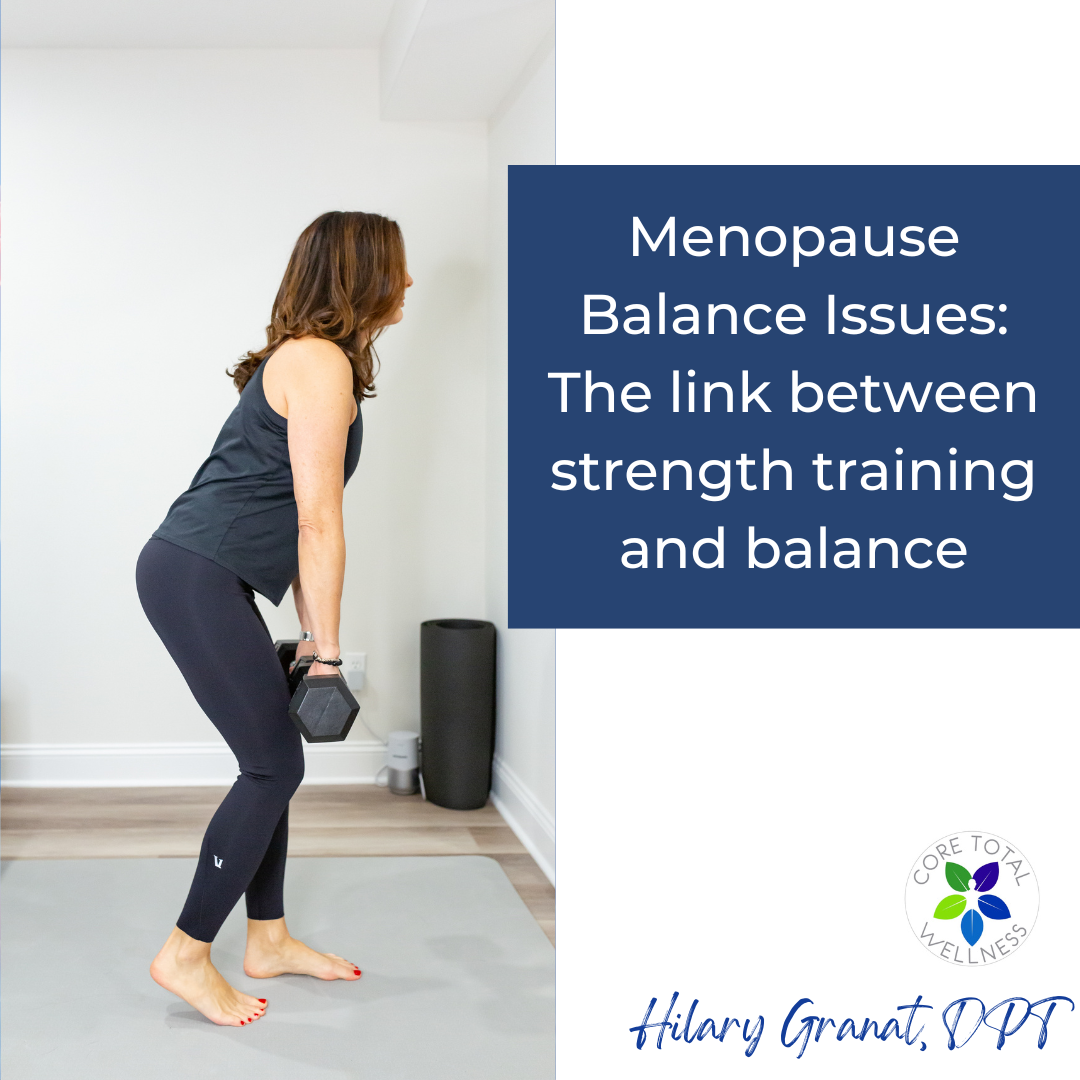
Menopause Balance Issues: The Link Between Strength Training and Balance
Menopause balance issues are often rooted in declining muscle strength rather than simple clumsiness. As estrogen levels drop and muscle mass decreases, reaction time slows and the risk of falls and fractures increases.
Strength training plays a critical role in maintaining stability, power, and confidence through midlife. In physical therapy, I often see how building targeted strength in the hips, legs, calves, and core improves balance more effectively than balance drills alone.
Improving balance is not about standing still on one leg but about preparing the body to react quickly in real-life situations. When women prioritize strength, they move better, feel steadier, and maintain independence as they age.
Are you in your menopausal years and noticing that your balance is not as good as it used to be?
As a physical therapist, I hear this from women in midlife all the time. I often work with clients who consider themselves active, but they have been injured while hiking on even surfaces, missing a single step outside, or simply catching their foot the wrong way. What starts as a small misstep can quickly turn into a sprained ankle, an injured knee or back or, in some cases, a fracture.
This isn’t about being clumsy. More often, they are signs that the systems responsible for balance, particularly muscle strength, need support.
What Happens to Balance and Strength As We Age
Our balance and strength naturally decline with age unless we are proactive about maintaining them. In my experience, balance issues in midlife are very often a strength issue. And, fortunately, strength training is one of the best ways to improve balance.
The evidence supports this.
Falls are strongly linked to declines in muscle strength and muscle power.
As strength decreases, balance reactions slow, falls become more likely, and when bone strength is also reduced, the consequences can be serious.
What I mean by that is that the numbers aren’t good when it comes to fractures and long-term outcomes after a fall. Things can go downhill quickly after a fracture, not because of the fall itself, but because the body no longer has the strength and resilience to respond and recover.
What changes during menopause (and aging in general) that affect balance
There are a few things that change during menopause that directly affect balance and strength.
Estrogen Loss: Estrogen helps maintain bone density and muscle mass; its decline accelerates bone loss (osteoporosis) and muscle weakness (sarcopenia).
Joint & Proprioception Issues: Reduced estrogen can stiffen joints and impair proprioception (body's spatial awareness), affecting stability.
Increased Fall Risk: Weaker muscles and bones, plus poor balance, raise the risk of falls and fractures, especially hip fractures
So why does strength matter so much for balance?
Balance challenges rarely happen when you’re standing still. They tend to happen when you’re stepping off a curb, turning quickly, reaching for something, or walking on uneven ground. In those moments, your body has only a split second to react and that reaction depends on strength.
This is also why simply being “active” isn’t always enough. Walking, hiking, and daily movement are great for overall health, but they don’t challenge your muscles to produce force quickly or under load. Strength training does. It teaches your muscles (and your nervous system) how to respond when balance is challenged in real life.
When strength declines, those responses slow and become less effective, which is when balance starts to feel unreliable. Strength training improves both muscle capacity and the nervous system’s ability to recruit muscles quickly. Strength training specifically targets type II (fast-twitch) muscle fibers. These fibers are responsible for explosive strength, balance recovery, and power. They decline rapidly with age if they aren’t trained, and activities like walking, jogging, or daily activities simply don’t stimulate them.
This is a key reason I prioritize strength training with women who want to feel steadier and more confident in their bodies.
Why balance exercises ALONE fall short
Balance exercises like standing on one leg (which I recommend to most of my patients while they are brushing their teeth) can be helpful, but they’re not enough on their own.
These exercises tend to test balance. Strength training builds the capacity needed to maintain it.
If your muscles don’t have the strength to support your body weight or respond quickly to a challenge, balance drills alone won’t fully protect you. For women in midlife and menopause, strength needs to come first, with balance work layered on top.
Saying all of that, we absolutely do need to train balance as well. Static and dynamic balance training is important in order to prevent falls and thus prevent fractures.
The key muscle groups that support balance
Not all strength training impacts balance equally. The greatest benefits come from strengthening:
Hips and glutes – for pelvic and side-to-side stability
Quadriceps and hamstrings – for knee control and confidence with movement
Calves – essential for ankle stability and quick corrections
Core (trunk stability) – to keep the spine stable and transfer force efficiently
Weakness in any of these areas often shows up as balance problems, even in women who consider themselves active.
The bottom line: Want better balance? Get Stronger
Losing your balance isn’t inevitable, and it’s not something you should just accept as part of aging. In my experience, strength training is one of the most effective, evidence-based ways to maintain balance, confidence, and independence through midlife and beyond.
Getting stronger doesn’t mean lifting the heaviest weights in the gym. It means building the strength to move well, react quickly, and trust your body so you can keep doing the things you love. Balance exercises have their place, but lasting balance comes from building strength, power, and neuromuscular control. And, if you’ve been following me for a while, you already know this: when you get stronger, you move better, feel steadier, and age with confidence.
Where to find resources on strength and menopause
It can feel incredibly overwhelming to know where to start with strength training, especially if you don’t feel like you know what you’re doing when it comes to lifting weights and getting stronger.
Here are a few ways I can help you:
Get on the waitlist for my 1:1 Meno-Strength RX program: Personalized monthly fitness programming for women in menopause and midlife developed by a Doctor of Physical Therapy.
Empower Hour: 1:1 Coaching Session: This highly personalized session can be centered around a specific area that you need coaching on to help you meet your goals and answer any questions you have about menopause and strength training. You will leave this call with a newfound clarity and direction to help you move forward.
Grab my FREE Meno-Strength Sampler (just fill out the form below!): A look inside my Meno-Strength 8-Week program and a way for you to get started TODAY!
[FREE] Get access to my Meno-Strength™ Sampler Program
A FREE sample program that will get you started with strength training in midlife and menopause and beyond. Just type your first name and email below and it will be sent to you! Be sure to check your spam if you don’t receive it within a few minutes!