Menopause Weight Lifting Plan: The Essential Components
A menopause weight lifting plan must address the hormonal and physiological shifts that impact muscle, metabolism, and bone density in midlife. As estrogen declines, maintaining lean muscle and strength becomes essential for protecting joints, supporting insulin sensitivity, and preserving long-term health.
Effective programs prioritize progressive overload, compound movements, adequate recovery, and consistent effort rather than excessive cardio or random workouts. Through my Meno-Strength RX program, I help women build sustainable strength routines that support balance, power, and confidence at every stage of menopause.
Strength training in midlife is not about spending hours in the gym but about lifting with intention and enough intensity to stimulate change. When done consistently and intelligently, weight lifting becomes one of the most powerful tools for aging strong and independent.
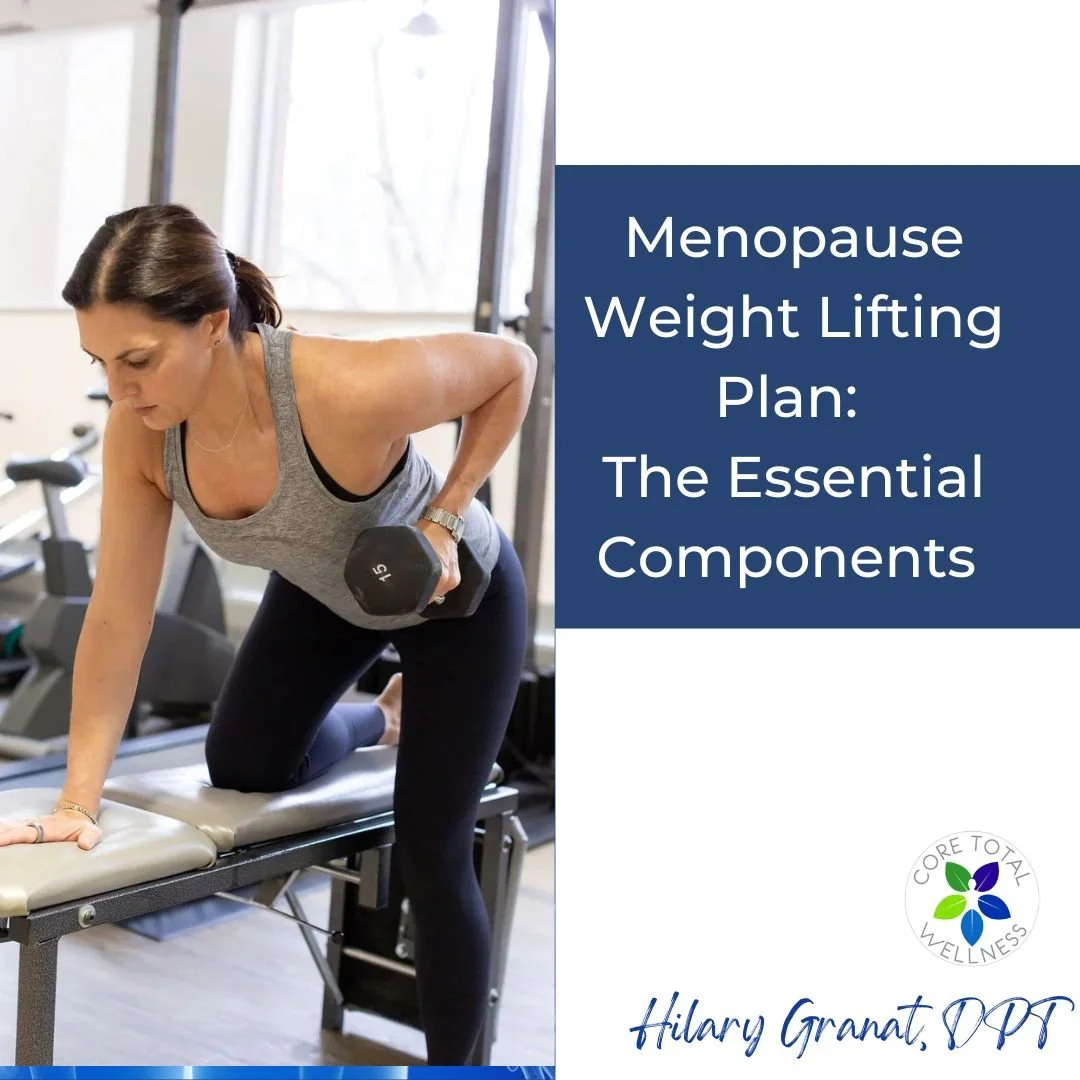
Menopause (and just getting older) changes everything. Muscles shrink, metabolism slows, bones weaken, and your body stores fat differently. What worked in your 30s just doesn’t cut it anymore. If you are reading this, I know you know exactly what I am talking about. But, it doesn’t need to stay that way.
Weight lifting is actually your secret weapon in midlife and beyond. It builds lean muscle, supports metabolism and insulin sensitivity, protects your joints and bones, and improves balance, power, and confidence.
If you are new to strength training, don’t worry. You don’t need to spend hours in the gym to see results and things don’t need to be complicated. I am going to break down the key components of a menopause weight lifting program so you can lift smarter, not harder.
#1: Frequency (How Often to Lift)
For menopause and midlife, less can actually be more. The minimum effective dose is working each muscle group 1-2 times a week on non-consecutive days. Consistency matters more than cramming in extra sessions. You should give each muscle group at least 48 hours to recover between workouts. Your muscles actually get stronger during recovery, not when you are lifting weights. There definitely is a balance. If you lift too little, you won’t see results. If you lift too much and you risk fatigue, injury and not getting the results you are seeking.
For most women, 2 to 3 strength sessions a week produce the best results. Skipping a workout occasionally is fine, but showing up week after week is what truly builds strength, protects your bones, and keeps your body resilient. Consistency is everything.
#2: Progressive Overload (The missing piece for most women)
Have you been using the same 10# weight and doing 10-12 reps forever for that same exercise? Well, that’s not going to work anymore. And, if you are currently lifting weights and not seeing results, this is usually the missing piece. Doing the same weights for the same reps eventually stops working because your body adapts.
The Progressive overload is the principle of gradually increasing the demands placed on your muscles over time so your body has a reason to adapt and get stronger. That increase can come from lifting slightly heavier weights, doing more reps, slowing the tempo (speed), or moving through an increased (or sometimes even decreased) range of motion. Without progressive overload, your body stays the same.
The key is to lift close to failure in 30 reps or less. More on this in the section “How many reps”. But, use heavy enough resistance to where you consistently approach muscle failure by the end of each set.
#3: Exercise Selection (What to Lift)
When it comes to strength training, what you lift matters. Research shows that compound movements that work multiple muscles at once are the most effective and efficient. Think squats, hinges, pushes, pulls, and carries. These exercises give you the biggest bang for your buck.
That said, I also like exercises that target one muscle group at a time, since this ensures the muscle gets a high-quality stimulus. As a woman in midlife myself with back issues, I know not everyone is comfortable with certain exercises, like a deadlift. I always recommend choosing exercises that feel good for your body. There are so many exercise options, and if something doesn’t feel good, you can always find a different exercise that does.
I don’t recommend combination moves that don’t effectively target any one muscle group, such as burpees or a squat-to-overhead press. These types of exercises are targeting the upper and lower body at the same time or claim to work everything. Getting close to muscle failure is crucial for muscle growth, and by combining an upper and lower body lift, you won't approach failure in either area. This is because the upper and lower body will require different amounts of resistance to get close to muscle failure within the same time frame. More on this below.
Example: Full-Body Strength Workout at Home
Every effective strength program trains the body through a handful of basic movement patterns. This full-body workout can be done at home with dumbbells or kettlebells and hits all the major muscle groups.
Squat: Goblet squat
Hip hinge: Dumbbell deadlift or hip thrust
Horizontal push: Push-ups or dumbbell chest press
Horizontal pull: One-arm dumbbell row or band row
Vertical press: Dumbbell overhead press
Vertical pull: Band lat pulldown or assisted pull-up
Optional carry or core: Farmer carry or dead bug
#4: How Many Reps & Sets?
There isn’t one perfect rep number. Muscle responds to effort more than an exact rep count. Research shows that as long as you’re working within roughly the 6 to 30 rep range and reaching muscle fatigue within 70 seconds of time under tension, you can build both strength and muscle. This is crucial for muscle growth. If you can do more than 30 reps, the load is too light to build lean muscle.
Problems arise when you’re doing a predetermined number of reps, like following a plan that tells you to do 3 sets of 10, but you’re not feeling challenged by the 10th rep. In that case, you either need to increase the weight so the 10th rep feels hard, or keep going and do more reps.
In terms of sets, most women do best with 2 to 4 quality working sets per exercise, focusing on effort rather than just checking boxes. One hard set taken close to muscle fatigue is far more effective than multiple half-hearted ones.
That said, I usually recommend 3 sets of 8 to 15 reps, which is a great place to start for most women. It’s effective, joint-friendly, and easier to manage while still lifting with enough intensity to see results. What matters most is that the last few reps feel challenging and you’re finishing the set with only one or two reps left in the tank.
#5: Intensity & Effort (How hard Is “hard enough”)
To get results in midlife, your workouts need enough effort to challenge your muscles. That means lifting close to muscle fatigue, not stopping too early, but also not pushing to all-out failure every time. You should finish most sets feeling like you could do one or two more reps if you had to.
What matters most is getting close to muscle fatigue. That might look like 8 heavier reps or 15 lighter reps. As long as you’re finishing the set with only one or two reps left in the tank, you’re going to see results.
#6: Consistency
Consistency is what actually drives results. This is why I love full-body workouts 2 to 3 times a week. Life gets busy, and this approach makes consistency far more realistic. Compared to 4-5 day split routines (like push/pull or upper/lower), full-body training is easier to maintain and just as effective (often more so) because it allows for better recovery. I also include unilateral work to support balance and core training that goes beyond crunches, focusing on stability, control, and the ability to handle load.
#7: Recovery & Rest (Where results actually happen)
Recovery isn’t optional. It’s where your body actually gets stronger. Read that sentence again. Sleep, rest days, and giving your nervous system a break are just as important as the workouts themselves. Adequate rest between sets matters too. If you rush through your workouts without allowing enough recovery, you won’t be able to lift with the intensity needed to see results. Without proper recovery, you risk fatigue, injury, and not seeing progress.
Here are some signs that you’re not recovering well: lingering soreness, low energy, irritability, or trouble sleeping. In menopause, more is not better.
Common mistakes women make with weight lifting in menopause
A lot of women keep doing what worked in their 30s and even 40s and wonder why it’s not working anymore. Too much cardio and not enough strength work, avoiding heavier weights, jumping from program to program, ignoring recovery, or training like they did a decade ago are all mistakes that hold you back. The good news is, once you fix these, progress comes faster than you think.
If you’re looking for guidance, want to see what a balanced strength program looks like, or just want a FREE sample week, check out my Meno-Strength Sampler HERE. It’s a great resource to help you lift smarter and feel stronger without the guesswork required.
Think of lifting as your personal health insurance: the stronger you get now, the stronger your future self will be. And, it's never too late and you're never too old. You can make muscle gains at any age. So, let’s do it!
Where to find resources on strength and menopause
It can feel incredibly overwhelming to know where to start with strength training, especially if you don’t feel like you know what you’re doing when it comes to lifting weights and getting stronger.
Here are a few ways I can help you:
Get on the waitlist for my 1:1 Meno-Strength RX program: Personalized monthly fitness programming for women in menopause and midlife developed by a Doctor of Physical Therapy.
Empower Hour: 1:1 Coaching Session: This highly personalized session can be centered around a specific area that you need coaching on to help you meet your goals and answer any questions you have about menopause and strength training. You will leave this call with a newfound clarity and direction to help you move forward.
Grab my FREE Meno-Strength Sampler (just fill out the form below!): A look inside my Meno-Strength 8-Week program and a way for you to get started TODAY!
[FREE] Get access to my Meno-Strength™ Sampler Program
A FREE sample program that will get you started with strength training in midlife and menopause and beyond. Just type your first name and email below and it will be sent to you! Be sure to check your spam if you don’t receive it within a few minutes!